Sociology alumnus working to improve health outcomes for women, children
August 26, 2026 - Karessa Weir
 Moving from lectures and research into real-life work to improve health outcomes for mothers and children, MSU Sociology alumnus Corinne Mansour feels her time at Michigan State University has been completed in the best way possible with her summer internship in Flint.
“It’s like my time at MSU was just wrapped up perfectly,” said the spring 2026 graduate.
Mansour served as a pediatric public health intern with the Rx Kids program in Flint, part of the C.S. Mott Department of Public Health in the College of Human Medicine.
Her role was as a qualitative research assistant for the prenatal and infant cash prescription program that supports children, mothers, and families. There she was able to focus on child and maternal vitality and public policy initiatives and programming.
“It was the perfect transition for me from my undergraduate work in Sociology into my master's program in social work at the University of Chicago,” she said. “It was a great opportunity to apply the sociological theory I learned into meaningful practice.”
Mansour knew coming in as a first-year student at MSU that she wanted to work with children. She started in elementary education, switched to psychology, and found a home in MSU Sociology.
“The SOC department is a great community. I wouldn’t have done my undergraduate education any other way,” she said, calling out mentors including Drs. Jennifer Carrera, Sarah Prior, Cliff Broman and PJ Pettis.
Mansour took Dr. Carrera’s SOC 282, quantitative research methods course. Impressed by Mansour’s curiosity and drive, Dr. Carrera invited her to be an undergraduate learning assistant (ULA) in SOC 281, which introduces students to both qualitative and quantitative research methods, and the more advanced SOC 282.
Dr. Carrera said, “I have witnessed her drive and passion to learn new skills and have new professional experiences to pursue a robust skillset in preparation for her future career.”
But it was her work in Flint that gave her the first chance to try out her new sociological skills and confirm it is something she can see herself doing full time.
“There is a lot of overlap between public health and sociology,” she said. “I was able to see how the social determinants of health such as access to transportation, healthcare, education, and social and behavioral contexts influence the quality of one’s health. Health does not exist in a vacuum.”
Growing up in DeWitt, Mansour was aware of Flint’s history of economic disenfranchisement and environmental disinvestment, but it was important to her to see what the community was like on the ground level. When she saw the internship posting, she recognized it as an opportunity to study adverse childhood experiences related to medical social work.
“The position directly aligned with my values and my professional interests,” she said. “I wanted the chance to work with overlooked populations like mothers and children who are especially vulnerable.”
Part of her work was going through voluntary maternal health surveys that dealt with issues, such as financial stability, mental and physical health, family resources, and social support. At times she found herself in tears reading the responses. But these surveys humanized data for her in a way that large population data sets never could.
“You can read poverty and co-morbidity statistics, but they feel disconnected and tend to generalize. But each of these responses was personal and showed me that you can’t summarize one person’s life based on others’ experiences. You have to humanize the data,” Mansour said.
She was also inspired by the chance to work alongside Dr. Mona Hanna, Associate Dean for Public Health and C.S. Mott Endowed Professor of Public Health. Dr. Hanna founded the Pediatric Public Health Initiative and Rx Kids.
“Dr. Mona is fantastic,” Mansour said, adding that she also learned from Associate Director Jenny LaChance, Project Manager Maya Wolock, Dr. Crystal Cederna and Dr. Rachel Hollander during her internship.
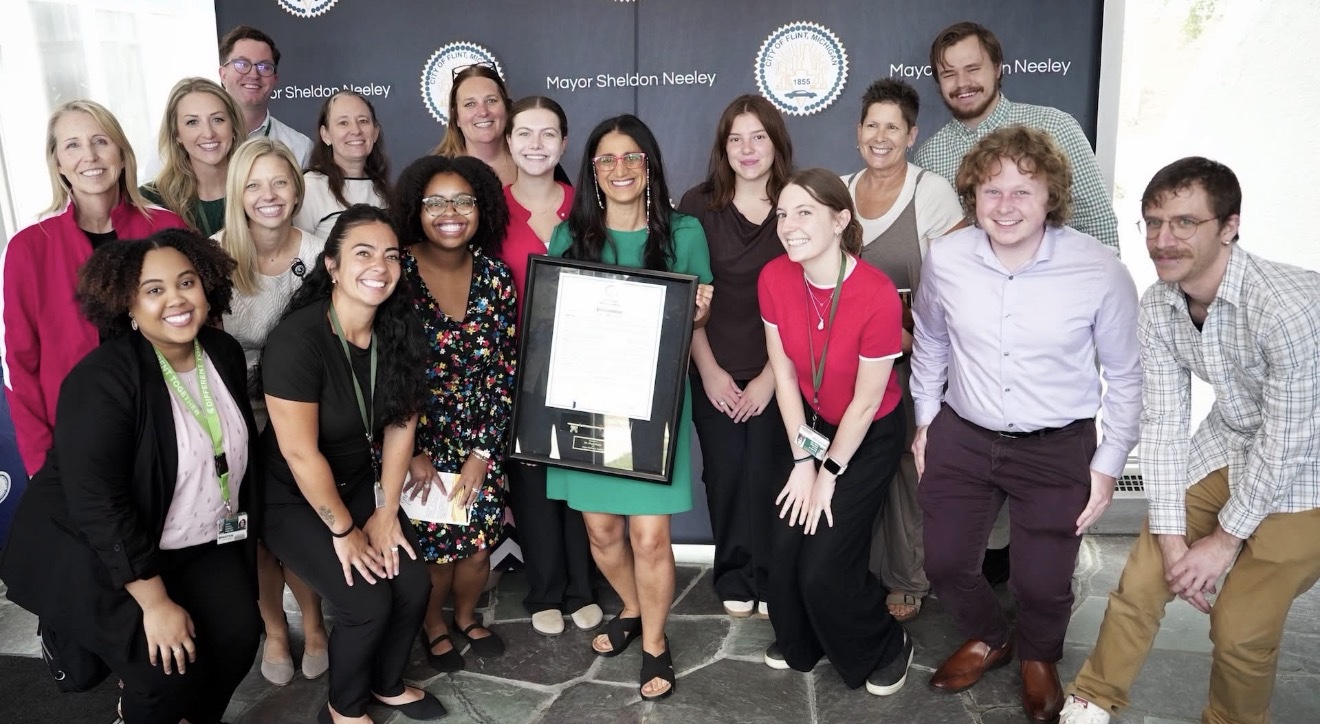
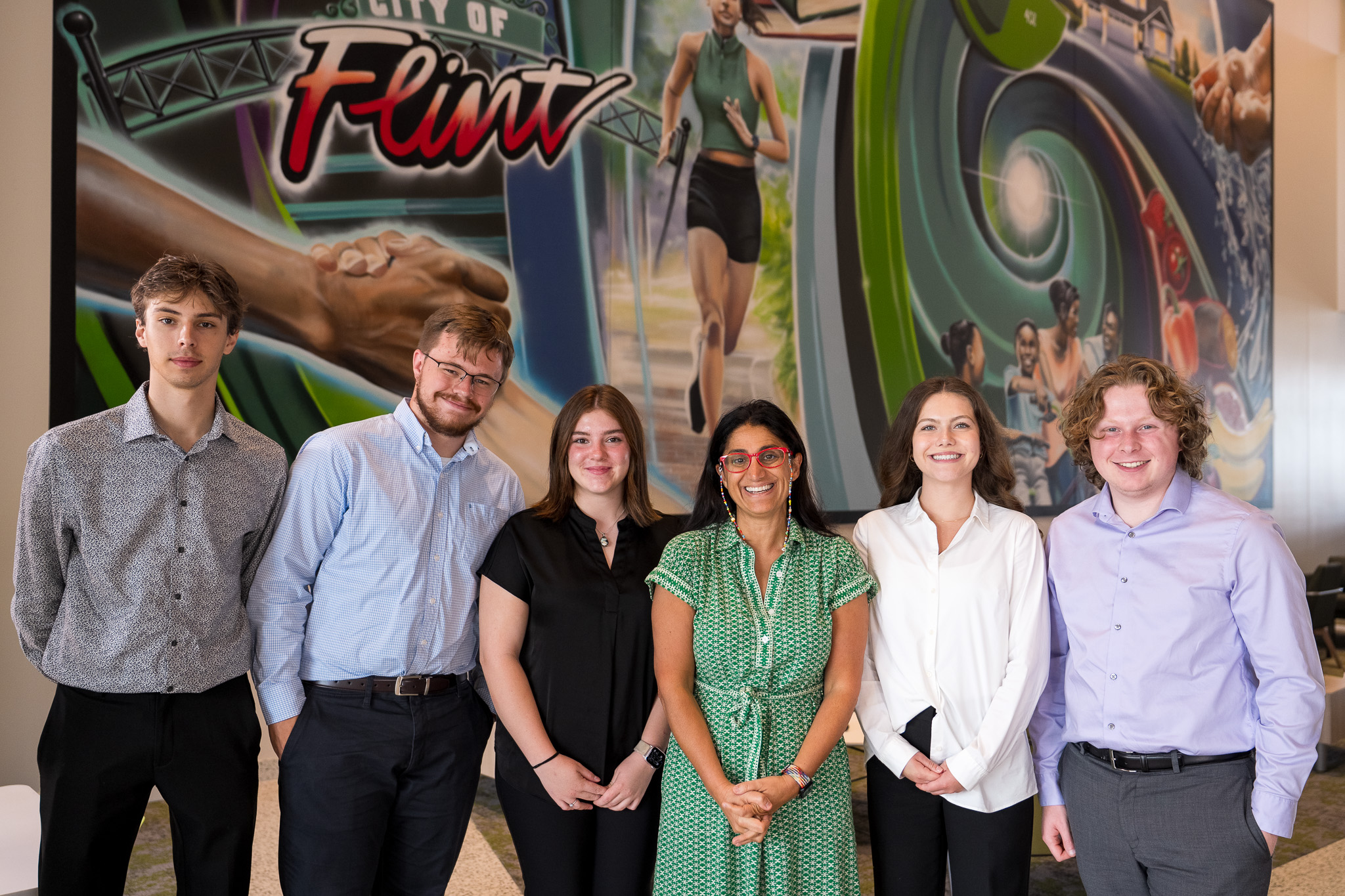
She worked with other interns with diverse backgrounds including nursing, pre-medical, and economics.
“It was incredibly interdisciplinary. The faculty and staff all stressed the importance of this collaboration,” she said.
Dr Carla A. Pfeffer, Professor and Chair of the Department of Sociology, said: “A degree in Sociology here at MSU provides a perfect pathway for students preparing for careers in health, medicine, and society. Our world-class faculty have particular expertise in this area and provide many educational, research, internship, community outreach, and applied skills training and opportunities for outstanding students like Corinne.”
Mansour also learned a lot about the community of Flint – its resilience, resources and grassroots advocacy. Between this internship and a previous one with a domestic violence shelter in Charlotte—through an experiential learning opportunity led by Academic Specialist Cathy White—she feels prepared to handle work that will come with her MSW field placement.
“I learned a lot from the community of Flint,” she said. “You have to be willing to come into an unfamiliar place with an open mind and an open heart and being willing to form your own opinions through community engagement.”
Her end goal is to work as a medical social worker, helping children with adverse childhood experiences in a hospital setting, and working to alleviate disparities in healthcare.