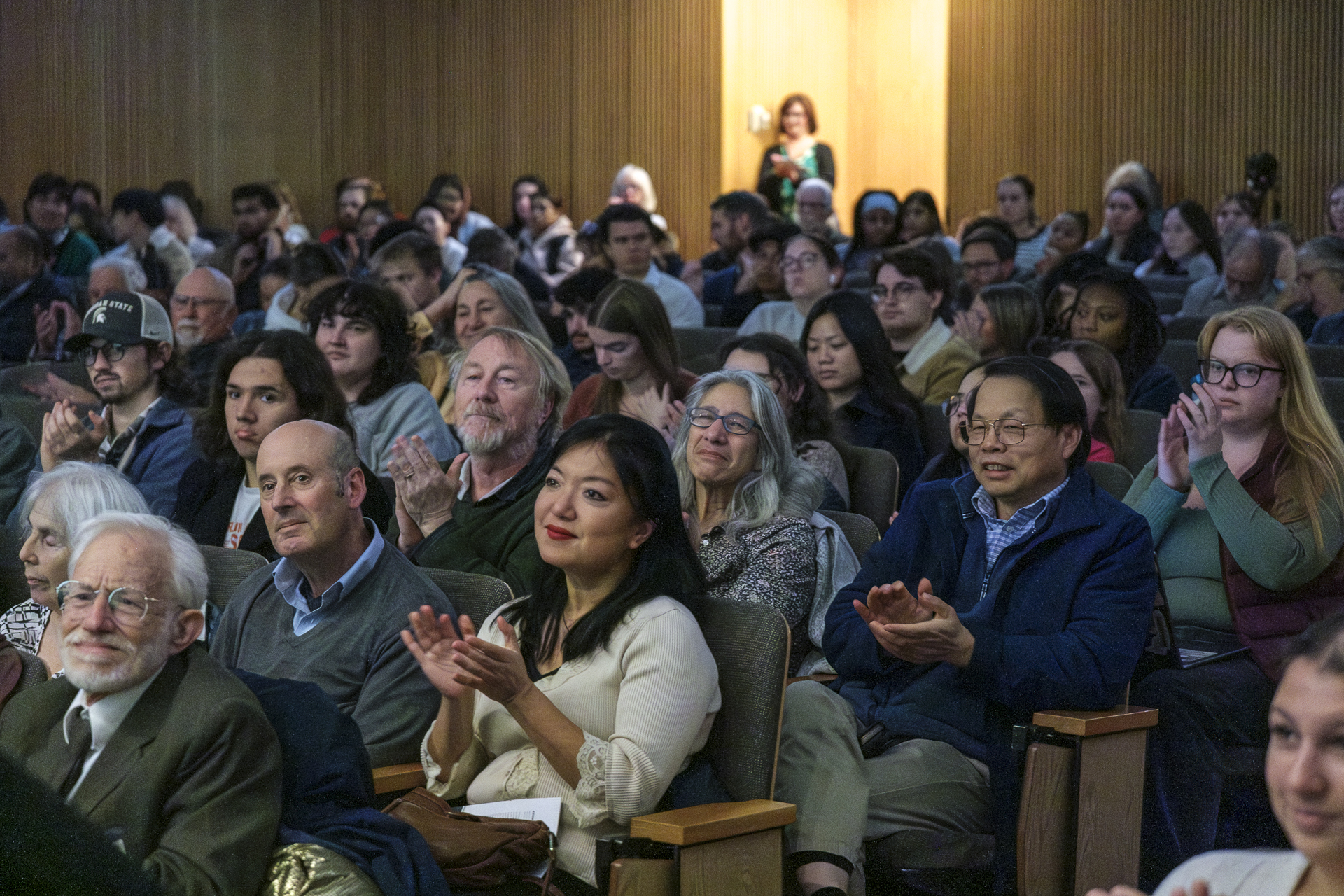
Tom Dietz returns to MSU to discuss "Making Better Decisions About Sustainability"
December 10, 2025 - Karessa Weir
Photos by Logan Fusciardi, College of Social Science
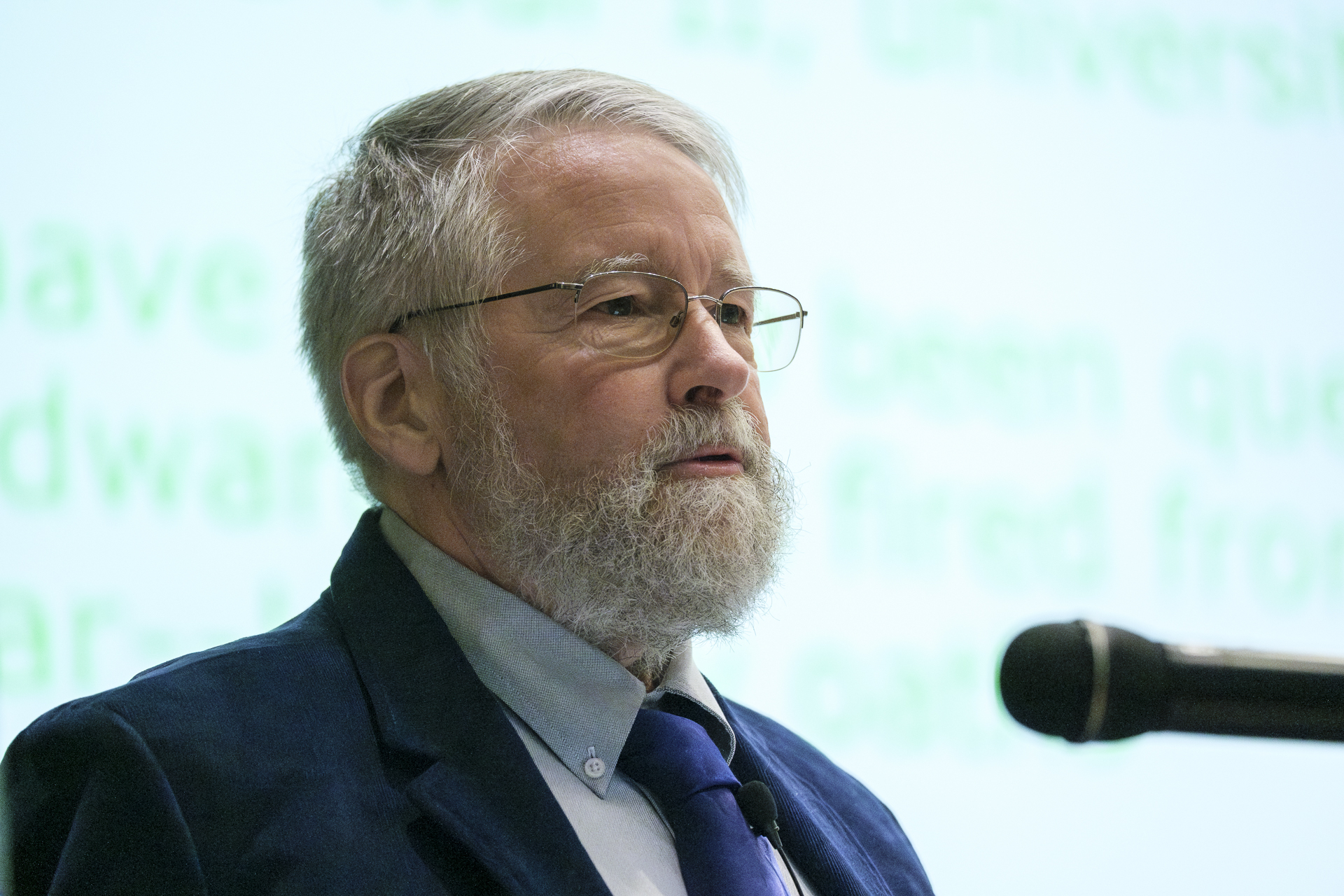 In his latest book “Decisions for Sustainability: Facts and Values,” University Distinguished Professor Emeritus Tom Dietz argued that the decisions of the 21st century will shape the future of humanity and of other species on the planet.
He continued that conversation this fall at Michigan State University as the 2025 Stan and Toba Kaplowitz Distinguished Lecture" Making Better Decisions About Sustainability" Nov. 5 in the Kellogg Center Auditorium.
“We’d like to improve human well-being, the well-being of other species and be able to protect the environment. That’s what I call sustainability,” Dietz said. “But we face a lot of challenges – climate change, new technologies like (artificial intelligence), new technology for weapons and many other changes call for effective responses.”
Making good decisions toward sustainability is difficult but people must always ask “can we do better?,” he said.
Sociology Professor Emeritus Stan Kaplowitz and his wife, Toba, created the Stan and Toba Kaplowitz Distinguished Lecture Series in 2024 with their inaugural lecture by renowned environmentalist Robert Bullard. This year, Dietz, a member of the National Academy of Sciences, was selected for the second lecture.
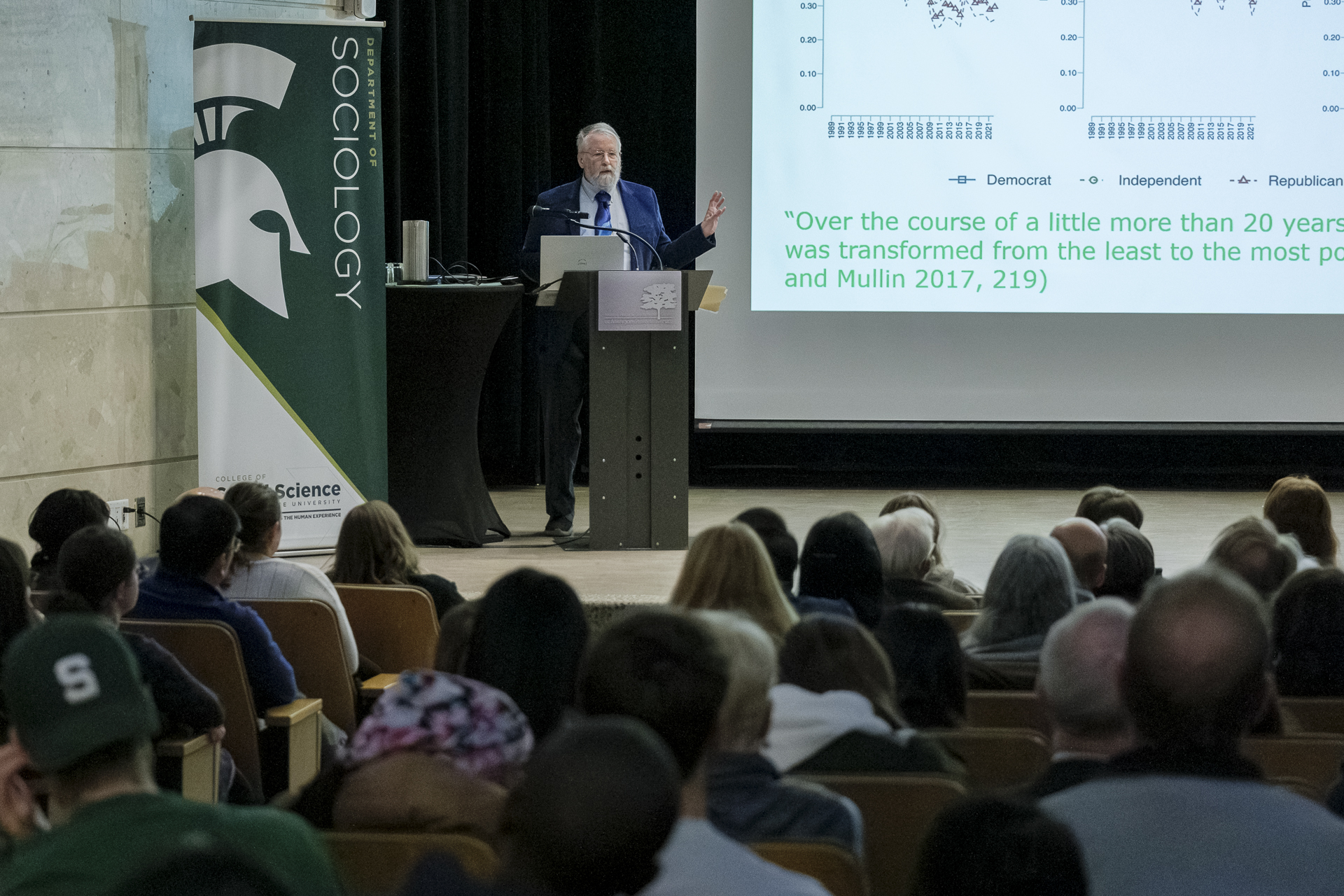 Dietz began the lecture by tracing his personal roots of sustainability, environmental justice and activism to his undergraduate years at Kent State University, where he led the effort to hold the first Earth Day celebration in 1970. The celebration was cancelled after the Ohio National Guardsmen fired on unarmed student protesters, killing four and injuring 11.
He went on to his environmental attitude surveys when he talked to people about the polluted state of the Cuyahoga River in northern Ohio. He documented the desires of the people of Kent to clean up the river and provide more access. Dietz’s work was cited in discussions on the politics of the river and eventually led to action.
“People in Kent really wanted more access to the river. They wanted it cleaned up,” he said. “And now the river is beautiful and it’s been restored. The problems have been alleviated. Part of it is actually a national park.
So I left undergraduate school committed to interdisciplinary work, knowing that decisions mattered. But getting the facts right was important for good decisions.”
Dietz told the audience that the Doomsday Clock, set by Bulletin of Atomic Scientists, is now at 89 seconds to midnight, the closest to midnight that it has ever been since it was created in 1947. While it was designed to mark the risk of nuclear annihilation, it now includes factors such as climate change, AI and biological events that could also lead to catastrophe. That’s the downside of the current world situation.
The flip side is that people are living longer. But all of this data only go so far. It is values and norms that can influence good decision making, Dietz said.
“We have to acknowledge multiple forms of understanding and expertise, and use diverse viewpoints to drive our understanding,” he said. “An analytical deliberative process, where you’re getting people who have expertise on local situations together with scientists and working it through together.”
This kind of process allows you to get the science right and then learn how to apply the science to the local context, he said.
“You’re focusing on the science at the right place and it helps build trust and capacity for all those who participate,” Dietz said, citing MSU Sociology Associate Professor Jennifer Carrera’s work on water quality in Flint as “an exemplar of this kind of research.”
As well as more accurate data, it also feels better to work collaboratively with stakeholders, he said.
“The idea of having the public, all those interested in or affected by the decision involved in that decision seems to be ethically right,” Dietz said.
The problems come in when you factor in systemic issues such as income inequality, wealth concentration, corporate media strongholds and other pressures that allow one side to have a louder voice in the deliberations. So decision making becomes not just about facts and values but so much more.
“You don’t just take your facts and values but your beliefs about the facts and combine them with your position in the social structure – your values, your identity, your beliefs, your norms all influence each other and they influence decisions,” he said.
Research shows that people tend to accept facts consistent with their values, and that is determined in part by political ideology, especially in the US.
“The differences we’re seeing in the United States right now are not entirely driven by differences in values but driven by other things,” he said. “Before you accept new information, you review it based on whether it’s consistent with what you already believe and with your values, rather than just judging the value of that information on its own merits.”
Countering that biased assimilation of new facts has been the job of science communication which focuses on “how to get public understandings of science aligned with what the science really says,” Dietz said.
He ended his lecture discussing what an individual can do to make good, sustainable decisions.
“In all our discussions and interactions, it’s important to emphasize the evidence and to resist disinformation,” Dietz said. “So if somebody is making an argument, one can ask what the evidence is based on science under scholarship? Is it analysis by professional journalists? Is it based on personal experiences. Personal experiences are valid but you have to ask how does your personal experience generalize to other people?”
“We have to find ways to encourage broad discussions across the spectrum,” he said. “We have to view it as an ongoing process. These issues have been going on for several hundred years, certainly for the last 100 years. We’re never going to get it entirely right but we have to realize that we’re going to need to experiment.”
Finally, Dietz encouraged the audience to engage with public officials, volunteer as poll workers, and serve on board and commissions.
At MSU, Dietz was founding director of the Environmental Science and Policy Program and active in Sociology, Animal Studies and the Center for Systems Integration and Sustainability. He retired from MSU Sociology in 2023.
Dietz is a member of the U.S. National Academy of Sciences, a Fellow of the American Association for the Advancement of Science and has won the Sustainability Science Award from the Ecological Society of America. Decisions for Sustainability: Facts and Values (Cambridge) won the Gerald R. Young Book Award from the Society for Human Ecology.