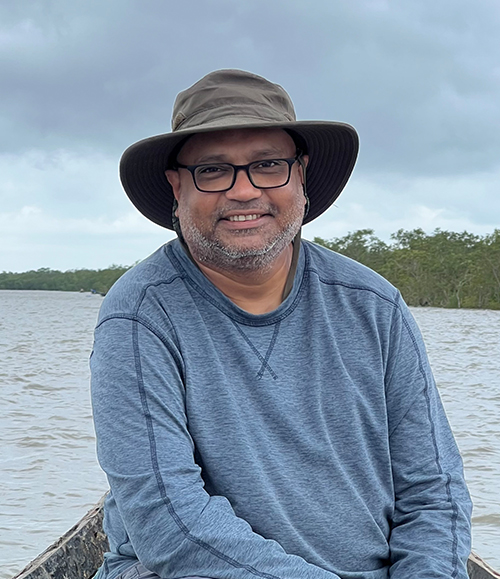
When it comes to adapting to climate change, upward mobility only happens if everyone works together, a new MSU Sociology research project has found.
In a project led by Dr. Raka Sen of Arizona State University, MSU Sociology Assistant Professor Dr. Saleh Ahmed studied families’ everyday adaptations to climate change and found that families who were pursuing individual land ownership and entrepreneurship were losing money and security.
Meanwhile, families using collective wage labor, employment in non-governmental organizations (NGOs) and skill-based innovations “demonstrated greater resilience and wealth accumulation,” authors wrote.
“Strategies that emphasize individual asset accumulation increase climate vulnerability,” authors found. “Whereas strategies that emphasize collected and placed-based knowledge are more successful at providing economic security.”
But even when the families understand they would be better off working together, they are held back by traditions, development models and economic structures that emphasis the individual over the group.
The study “Temporality, Everyday Adaptations, and Arrested Mobility in the Sundarbans” was published in a special issue the journal Sociology of Development on Solving Global Poverty.
Ahmed, Sen and Mahmuda Akter (Plan International, Bangladesh), focused on everyday people living in the Sundarbans region of India and Bangladesh. They looked at how people adapted their labor to changes in the climate. They found that while people value working for themselves over working for others, it is only when people with “limited resources can mobilize them to simultaneously adapt to climate change and strive for some semblance of upward mobility.”
Adaptation in these communities includes switching crops, rebuilding homes, or moving to a larger city for work.
But much of the organized work toward adaption comes with inherent power structures that focus on technology such as solar initiatives over community priorities like rainwater harvesting.
“National policies often prioritized environmental protection over socioeconomic resilience, ignoring their interdependence. Adaptation projects typically follow top-down development models that produce maladaptive outcomes, worsening community vulnerability rather than building the locally grounded resilience families need,” the researchers found.
The group followed 16 families in the Sundarbans region (world’s largest mangrove forest) of Bangladesh, an area hard hit by cyclones which threaten their fresh waters supplies and overall food security. Through monthly check-ins, authors recorded the lived adaptation of each family. Traditional areas of farming, forest-resource collecting and fishing are all threatened by the rising temperatures and unpredictable rainfall.
“All 16 families acknowledged that their current working patterns are unsustainable, saying things like “how can we keep working like this” or “we are working ourselves to death,” yet the immediate pressures of survival leave little choice but to continue this intensive adaptation labor,” authors found.
Searching for alternatives, families have traditionally looked to education, marriage or starting their own businesses to increase their income and position.
However, the research found that entrepreneurship is even riskier in an unpredictable climate. Increases in livestock only brought short-term benefits and opening shops led to greater family debt. Both of these decreased the family’s health and prosperity.
The families who were seeing greater savings and mobility were those who worked for others, incurring less risk and higher wages.
Similarly land ownership in salinity-prone areas is no longer the path to stability. Instead it is becoming more of a liability during worsening climate conditions. Families are less flexible and loans can trap them in debt cycles. The traditions where men’s work is valued more than women’s are being re-evaluated as being as vital to a families’ success.
“Breaking the climate-poverty cycle calls for restructuring development toward place-based strategies that build on local knowledge and geographic advantages,” authors wrote. “The solution lies both in rethinking capitalist imperatives and colonial development logics and in co-producing new understandings of climate-changed mobility among families, local organizations, and critical researchers.”