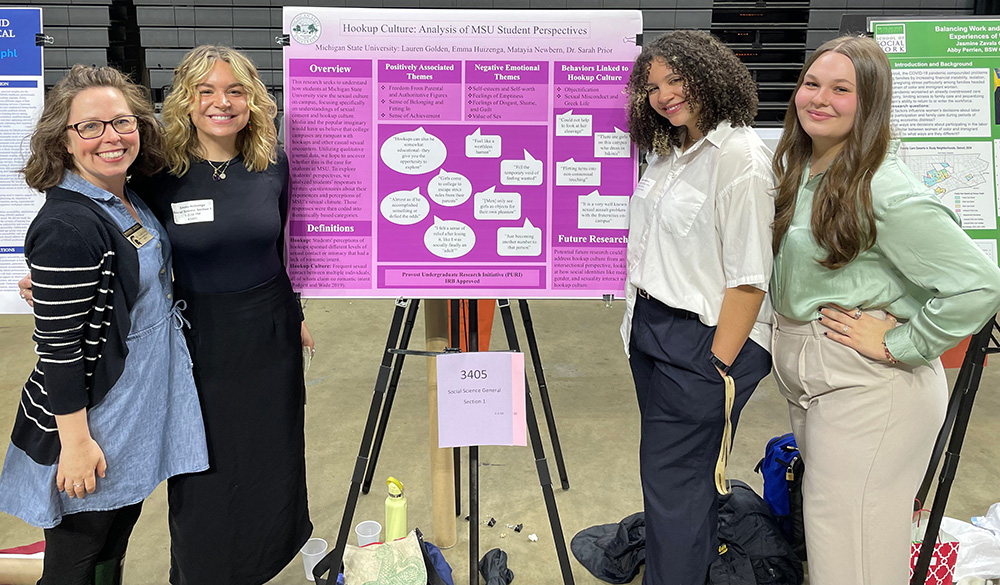
Lauren Golden, Emma Huizenga, Cassidy Versen and Matayia Newbern’s article “College Students’ Perceptions of Hookup Culture Through a Social Ecological Lens” was published in the journal Sexuality & Culture and co-authored with Dr. Sarah Prior, MSU Sociology Associate Professor, Undergraduate Program Director and Director of the Campus Sexual Culture Lab.
The researchers evaluated 110 journal entries that show hooking up has both social and emotional impacts. Benefits can include feelings of belonging and fitting in, while drawbacks include feelings of emptiness, disgust and shame. They define hookups as times when participants engage in some level of sexual activity that is free from the obligation to form any ongoing, committed romantic relationship.
“We situate these experiences within a social ecological model to understand the broader campus ecosystem and how multiple and often competing narratives and institutions collide to create the campus social and sexual environment. While broader cultural narratives would have us believe that everyone on campus is engaging in hookups, our research shows a more nuanced understanding of how and why these students hook up, or do not hook up, and how those experiences relate to their understanding of broader gendered sexual scripts,” they wrote.
The research team found that on one hand, “hookup culture still primarily benefits and is framed by male heterosexual, cisgendered” people.
“Our respondents suggest that social notions of heterosexual gender roles still permeate campus sexual culture and that issues of objectification, harassment and abuse still exist at all levels of the social ecological model,” they wrote.
However, they also found that today’s more modern hookup culture has the potential to provide the freedom to explore and can provide some women an avenue to make choices outside of institutionalized expectations.
“Our respondents presented a more nuanced understanding of the campus sexual ecosystem and the ways that students make sense of their own experiences,” they found.
This publication has far-reaching implications for the careers of these young researchers, said Dr. Carla A. Pfeffer, Chair of MSU Sociology.
“Faculty collaborating and publishing original research with students is one of the surest pathways for students’ continuing success in applying for graduate school, on the job market, and in career professionalization. For those who wish to go to graduate school, having published peer-reviewed research provides clear evidence of one’s readiness to take on the tasks of graduate study and makes one’s application for graduate study much more likely to get noticed by admissions committees at top research institutions. In the nonprofit, government/policy, and corporate sectors, being a published author also serves as a strong signal that one is a recognized expert in a research area, has the methodological skills to take on advanced data analysis, and is able to effectively communicate scientific evidence to both teams of experts and the public more broadly,” Pfeffer said.