• Jump to Header
  • Jump to Main Content
  • Jump to Footer
Michigan State University
Department of Sociology
  • People
  • Give
  • Intranet

College of Social Science

Department of Sociology

  • Academics
    • Overview
    • Majors, Degrees, and Programs
    • Undergraduate
    • Graduate
    • Why Sociology
    • Advising
    729260110_18558827995070391_8154243596568427177_n

    Experiential Learning

    Learn More
  • |
  • Research
    • Overview
    • Research Centers and Programs
    • Faculty Books
    • Health, Medicine and the Body
    • Race, Class, Gender, and Sexuality
    • Environment, Migration and Movements
  • |
  • People
  • |
  • News
  • |
  • Events
  • |
  • About
    • Overview
    • Governance
    • Access, Opportunity and Excellence
    • Values and Mission
    • Committees
    • Contact Us
  • |
  • Alumni
Department of Sociology

College of Social Science

  • Academics
  • Research
  • People
  • News
  • Events
  • About
  • Alumni

< Academics

  • Overview
  • Majors, Degrees, and Programs
  • Undergraduate
  • Graduate
  • Why Sociology
  • Advising
729260110_18558827995070391_8154243596568427177_n

Experiential Learning

Learn More

< Research

  • Overview
  • Research Centers and Programs
  • Faculty Books
  • Health, Medicine and the Body
  • Race, Class, Gender, and Sexuality
  • Environment, Migration and Movements

< People

< News

< Events

< About

  • Overview
  • Governance
  • Access, Opportunity and Excellence
  • Values and Mission
  • Committees
  • Contact Us

< Alumni

  • People
  • Give
  • Intranet

March 20, 2025

Exploring causes of the Rohingya crisis in Myanmar

Karessa Weir

Dr. Saleh Ahmed, Assistant Professor of Sociology, is researching the roles that climate change, land laws and food insecurity have played on the ethnic cleansing of the Rohingya in Myanmar.  

His project, "Land at the Center of Climate, Capital, and the ‘Textbook Example of Ethnic Cleansing’ in Myanmar: Focus on the Rohingya Crisis" has been awarded a grant by the MSU Muslim Studies Program Strategic Partnership Fund, with matching funds from MSU Sociology. 
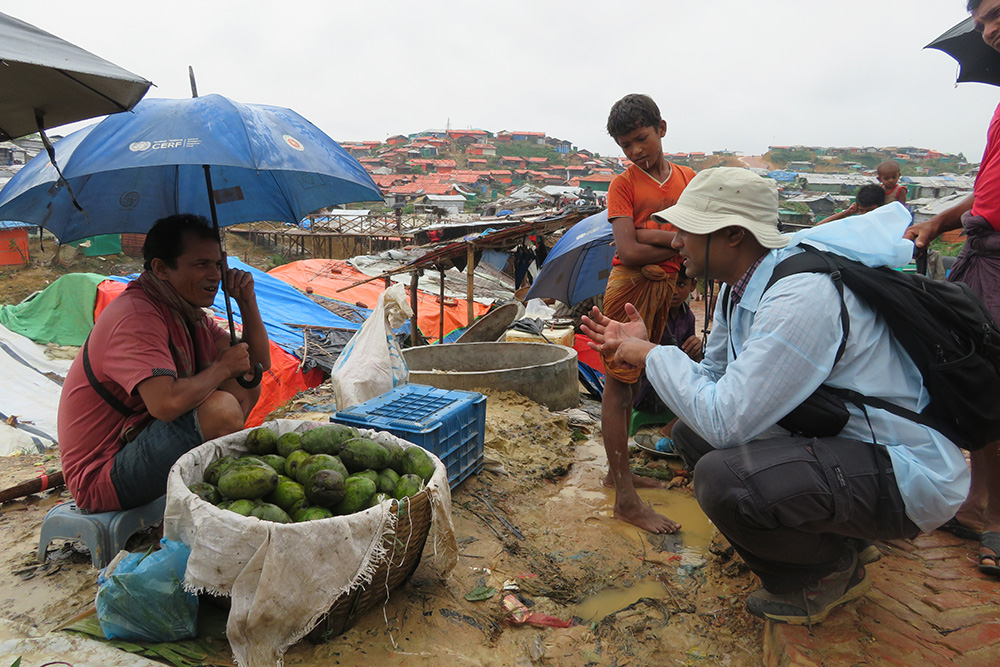
People gather and talk in a field in Myanmar.

The Rohingya is a stateless ethnic minority group who were forced to relocate from Myanmar to Bangladesh in 2017 in response to ethnic violence. Most narratives attribute the violence to cultural and religious differences. However, few fail to account for “the root causes of violence in the weaponization of land law, state terrorism and escalating climate causes,” Ahmed wrote. 

“Research has failed to understand the cause and manifestation of weaponized policies coupled with climate crisis, leading to a lack of identifying and monitoring state terrorism in the region,” he added.  

The state-sponsored policies and initiatives to acquire more land from the regions where minorities resided, together with an increase in flooding and cyclones from climate change, compounded the violence in Myanmar, which is regularly listed as one of the most climate-vulnerable countries in the world. 

This strategic partnership grant will allow Ahmed to establish necessary contacts and collect preliminary information in hopes of documenting the role of land laws in undermining the land rights of the Rohingya, how the intersection of gender, ethnicity and religion shaped individual land ownership struggles, and how recent climate extremes intensified regional food insecurities and land competition. 
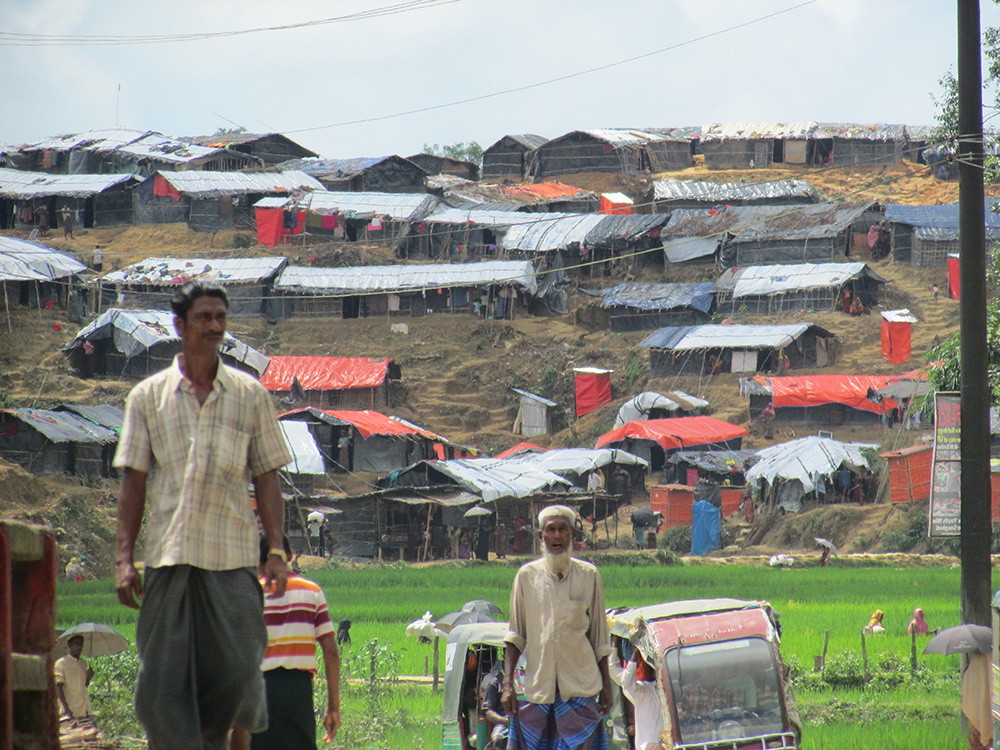
People gather and talk in a field in Myanmar.

“Specifically, overall research and necessary partnership will unravel the political economy of land and its intersection with ethnicity and religious differences among minorities, including forcefully displaced refugee populations in South and Southeast Asia,” Ahmed said. 

In addition, Ahmed is conducting research in coastal Bangladesh with a Delia Koo Endowment awarded earlier this year from the MSU Asian Studies Center. The project is titled, "Land and Climate Justice among Ethnic Minorities in Climate Vulnerable Coastal Bangladesh."  

“In the Delia Koo endowment, I will focus on climate adaptation challenges among marginalized populations in coastal Bangladesh,” he said. 

Ahmed’s research interest lies at the intersection of environment, development, and social justice. He received an interdisciplinary Ph.D. in Arid Lands Resource Sciences with a minor in Global Change from the University of Arizona. He also has a Graduate Certificate in Science Communication from the same institution. Ahmed’s previous degrees are on Environmental Sociology (Utah State University, UT), Regional Science (Karlsruhe Institute of Technology, Germany), Spatial Planning (KTH–The Royal Institute of Technology, Sweden) and Urban and Rural Planning (Khulna University, Bangladesh). 

  • Facebook

  • Instagram

  • Twitter

ACADEMICS

  • Overview
  • Majors, Degrees, and Programs
  • Advising
  • Undergraduate
  • Graduate
  • Why Sociology

NEWS & EVENTS

  • Events
  • News

RESEARCH

  • Overview
  • Environment, Migration and Movements
  • Health, Medicine and the Body
  • Race, Class, Gender, and Sexuality
  • Research Centers and Programs
  • Faculty Books

DIRECTORY

  • People

ABOUT

  • Overview
  • Values and Mission
  • Governance
  • Committees
  • Access, Opportunity and Excellence
  • Contact Us
  • Intranet

ALUMNI

  • Overview
  • Give

Contact us

soc1@msu.edu

Address

Department of Sociology
Michigan State University
Berkey Hall, Room 317
509 East Circle Drive,
East Lansing, MI 48824-1111

Follow Us

  • Visit our Facebook page
  • Visit our page on X
  • Visit our Instagram page
  • Visit our LinkedIn page
  • Visit our YouTube page

If you're having accessibility issues, please let us know.

Know More: Campus Safety Information and ResourcesTransparency Reporting: Budget & Salary/Compensation
  • Contact Information|
  • Site Map|
  • Privacy Statement|
  • Site Accessibility|
  • Call MSU: (517) 355-1855|
  • Visit: msu.edu|
  • Notice of Nondiscrimination|

SPARTANS WILL|© Michigan State University|